The origin story
I got into technology the unglamorous way: answering phones. In 1996 I was manning the phones on an 8-person phone-support team at WinBook Computer Corporation (a now defunct part of Micro Center), troubleshooting hardware and software issues with a customer on the line and no remote tools to see what they were seeing. You quickly learn how to ask effective questions. Later I was promoted to my first supervisory role, where I learned it's not about giving orders, but about enabling my team to succeed.
Almost thirty years later, I'm still doing the same core job — helping people who are having a bad day with their technology — just at a very different scale. What's changed is how much of the repeatable work I can hand off to a script, a knowledge base article, or, more recently, an AI-assisted workflow, so my team can spend their time on the problems that actually need a human brain.
What motivates me is watching a lean team outperform its headcount. At W.W. Williams, a team of three supported roughly 1,500 people — that only works because I obsessed over process redesign, automation, documentation, and elevating team members instead of just asking people to work harder. I built a PowerShell automation suite because manual Active Directory and license admin was eating hours we didn't have. I built ticket trend analysis because "we keep seeing this issue" doesn't really fly with upper management.
I'm genuinely energized by new technology, especially when it's early enough that most teams haven't figured out how to use it well yet. That's where I try to be useful — not just adopting a tool, but figuring out the training and workflow changes that make it actually stick. I did that with enterprise AI tools at work, and I do the same thing at home, where my personal homelab and my own AI ops assistant are a permanent testbed for "does this actually save time, or is it just interesting?"
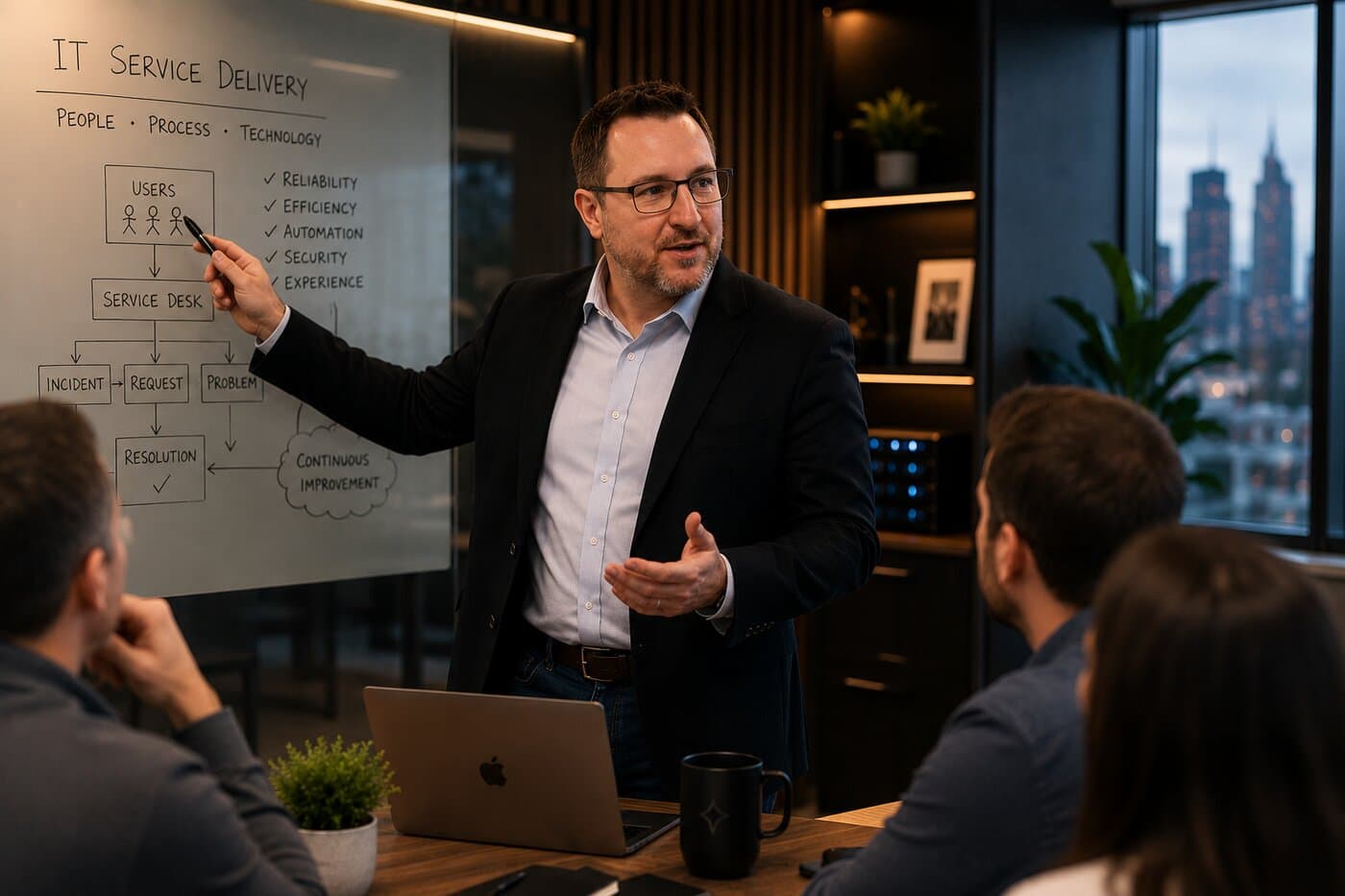
Automate the repeatable, document the rest, and build a team that outperforms its staffing numbers.
- 📍 Columbus, OH
- 🕰️ 25+ years in IT, all of it in support & operations leadership
- 🧰 PowerShell, Bash, and increasingly Python
- 🏠 Runs a full Proxmox / UniFi / Tailscale homelab, on-call for exactly no one but himself
- 🤖 Built and deployed a personal AI ops assistant
Four things that show up in everything I build
I like the puzzle, not just the fix
A closed ticket is fine. Finding the root cause behind fifty closed tickets is the part that actually keeps me interested — that's what the trend-analysis and Pareto work at W.W. Williams was really about.
My job is to support the team, not just the tech
Every metric on this site—MTTR, CSAT, throughput—reflects a team effort, not an individual achievement. I believe a manager's job is to remove friction, coach with purpose, and create an environment where every team member can do their best work.
Automate first, escalate second
If a task repeats, it becomes a script before it becomes a habit. PowerShell and Bash aren't hobbies for me — they're how a 3-person team supports 1,500 people without burning out.
New tools get tested at home first
I don't wait for a vendor whitepaper to tell me if something's useful. My homelab and personal AI ops assistant are where I stress-test ideas like AI-assisted ops before I bring them to work.
From phone support to running the desk
Milestones, roughly in order — the full breakdown lives on the résumé page.
Started in CommunicationsThe Ohio State University
Began coursework in communications — you know, the catch all field that says: I don't know what I want to do yet.
Technical Support SupervisorWinBook Computer Corporation
First leadership role — supervising an 8-person phone-support team, years before ITIL, ITSM platforms, or Slack existed. Troubleshooting over the phone with no remote tools teaches you patience fast.
Desktop AnalystL Brands
Eight years supporting enterprise users in a large-scale retail environment — where I first started building repeatable imaging and deployment processes instead of doing each machine by hand. And where I got hands with Macs and Marketing teams. Macs = Fun. Marketing Teams = Demanding. Both = A great experience.
Service Desk ManagerHighlights for Children
Nearly a decade leading a mixed Mac/Windows support team, and the start of using Bash and PowerShell to automate away the most repetitive parts of the job — including a device imaging redesign that gave the team 350+ hours a year back.
ITIL Foundation Certified
Formalized the process-thinking I'd already been doing intuitively — incident, problem, and change management as a system, not a checklist.
Help Desk SupervisorCASTO Management Services
Supervised a 4-person team and rebuilt the knowledge base from scratch, proving that documentation is itself a force multiplier for resolution speed. This is where I learned to love managing a team of people who are smarter than me, and to focus on enabling them to do their best work.
IT Service Desk ManagerW.W. Williams
Took on a 3-person team supporting ~1,500 users — and leaned hard into automation and AI to close the gap between headcount and workload.
GrandMasterJ.com homelab — AI ops at home
Stood up a full home infrastructure stack — Proxmox, UniFi, Tailscale, Netdata — and later I brought the same AI-adoption philosophy home by deploying a personal AI ops assistant to help run and document it.
Supported enterprise AI adoption
Helped to roll Claude Enterprise into daily IT operations and trained my team on prompting for troubleshooting, documentation, and ticket summarization.
Built an AI-assisted support chatbot
Trained a chatbot prototype on real ticket history and knowledge base content to handle the questions that shouldn't need a human, freeing the team for the ones that do.